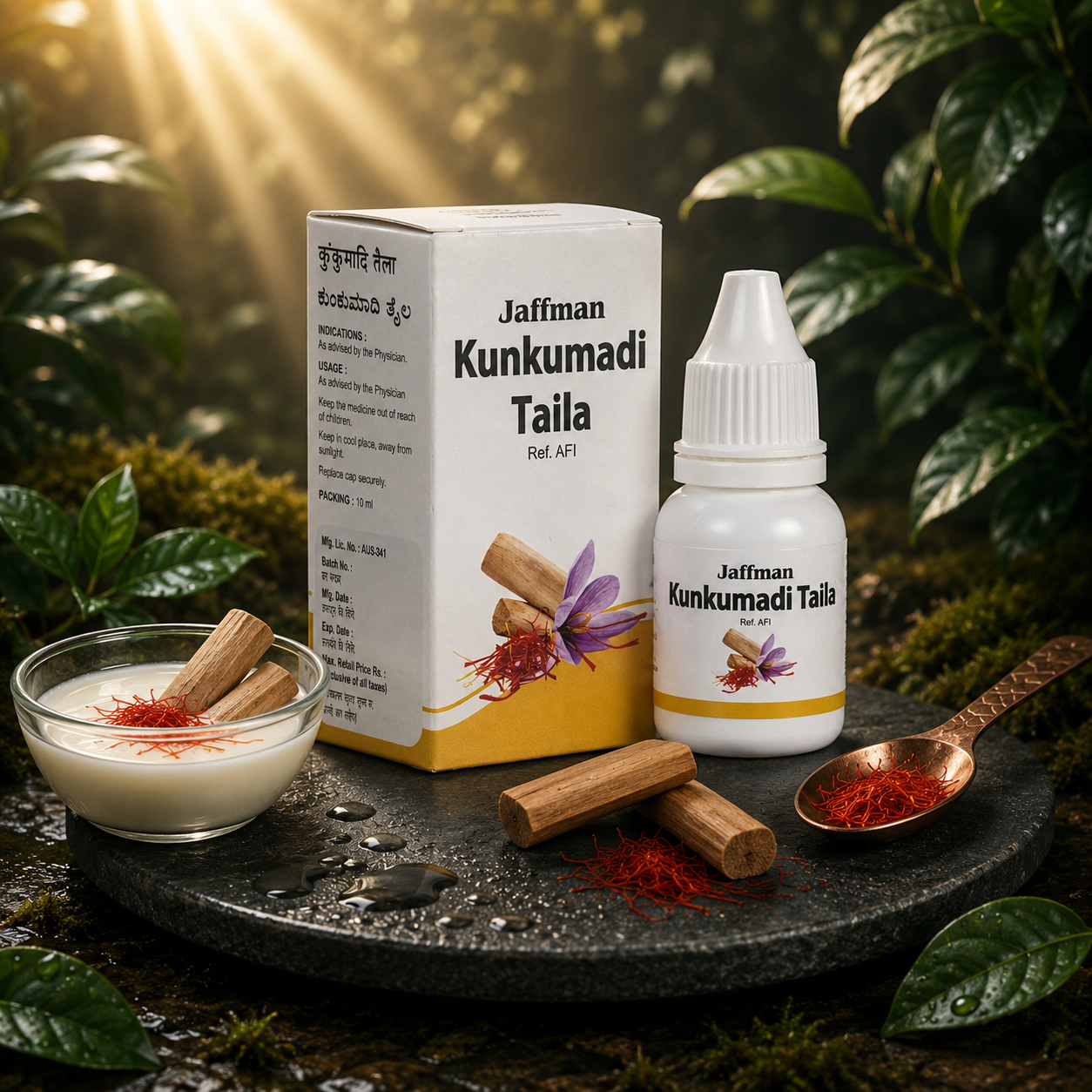
Kumkumadi Taila is a classical Ayurvedic facial oil prepared from precious herbs with Saffron (Kumkuma) as its key ingredient. Revered since ancient times, it is considered one of the most renowned Ayurvedic beauty formulations, known for enhancing natural skin glow and treating a wide range of skin disorders. Regular use is said to make the skin radiant like gold, as described in classical texts.
Why Choose Kumkumadi Taila Over Modern Cosmetics?
Many contemporary cosmetic products contain synthetic chemicals, preservatives, and artificial fragrances that may cause long-term skin damage, especially in people with sensitive or reactive skin. Prolonged use of such products can lead to irritation, pigmentation, dryness, and premature aging.
Kumkumadi Taila, being 100% herbal and naturally processed, offers a safer and holistic alternative. It works not only on the surface of the skin but also balances the underlying doshas, promoting healthy skin from within.
Classical Reference of Kumkumadi Taila
(Bharata Bhaishajya Ratnakara)
Ingredients of Kumkumadi Taila
Kumkumadi Taila is a synergistic blend of 27 potent Ayurvedic herbs, including:
1. Kumkuma (Saffron) – Crocus sativus
2. Chandana (Sandalwood) – Pterocarpus santalinus
3. Lodhra – Symplocos racemosa
4. Pathangam (Sappan wood) – Caesalpinia sappan
5. Raktha Chandana (Red sandalwood)
6. Kaleeyaka (White sandalwood) – Santalum album
7. Usheera (Vetiver) – Vetiveria zizanioides
8. Manjishta – Rubia cordifolia
9. Madhuyashti (Licorice) – Glycyrrhiza glabra
10. Padmaka – Prunus cerasoides
11. Padma (Lotus)
12. Kusta – Saussurea lappa
13. Gorochana – Purified cow bile
14. Nisha (Turmeric) – Curcuma longa
15. Laksha (Shellac) – Laccifer lacca
16. Daruharidra – Berberis aristata
17. Gairika (Red ochre)
18. Nagakesara – Mesua ferrea
19. Palasha Kusuma – Butea monosperma
20. Priyangu – Aglaia elaeagnoidea
21. Vatankura (Banyan bud) – Ficus bengalensis
22. Malathi (Jasmine) – Jasminum grandiflorum
23. Madhuchishta (Beeswax)
24. Sarshapa (Mustard) – Brassica juncea
25. Surabhi (Boswellia) – Boswellia serrata
26. Vacha (Sweet flag) – Acorus calamus
27. Tila Taila (Sesame oil) & Goat milk as base
Method of Preparation (Traditional Process)
· The herbs intended for Kalka (paste) are ground with milk until the required consistency is achieved.
· This Kalka is then processed with Sesame oil and Milk.
· The mixture is cooked over mild fire (Mridu Paka) until the medicated oil is prepared.
· The final product is known as Kumkumadi Taila.
Mode of Application
· Suitable for all skin types
· Take a few drops and gently massage over face and neck
· Massage in circular motions against hair follicle direction
· Can be:
o Applied overnight
o Washed off after a few hours
o Used as facial steam
o Used as Nasya (nasal drops) under guidance
Benefits of Kumkumadi Taila
1. Improves Skin Complexion
Saffron enhances natural radiance, reduces dullness, and improves overall skin tone.
2. Reduces Hyperpigmentation & Melasma
Antioxidant-rich herbs regulate melanocyte activity, helping fade dark patches and discoloration.
3. Natural Moisturizer
Vata-hara herbs along with sesame oil and milk maintain hydration and skin softness.
4. Acts as Natural Sunscreen
Protects skin from sun damage and helps treat sun tan and sunburn.
5. Heals Skin Infections
Its antiseptic and anti-inflammatory properties aid in healing wounds, scars, itching, and rashes.
6. Anti-Aging Action
Regular gentle massage improves cell regeneration, reducing fine lines and wrinkles.
Benefits as Described in Classical Texts
Kumkumadi Taila is indicated in:
· Vyanga: Facial melanosis characterized by bluish-black discoloration of the face.
· Nilika: Melasma, a form of hyperpigmentation caused by excessive melanin secretion, resulting in irregular patches of skin discoloration.
· Tilaka: Moles (nevi)—small, dark-brown spots caused by clusters of pigment-forming cells, occurring singly or in groups, and may appear anywhere on the body.
· Mashaka: Warts—small, fleshy bumps on the skin caused by papilloma viruses.
· Nyaccha: White or grey-colored patches on the skin.
· Mukhadooshika: Acne vulgaris / acne rosacea—eruptions on the face, commonly seen in adolescents, associated with hormonal changes.
· Padmini Kantaka: Round, elevated swellings with thorn-like eruptions on the surface.
· Jatumani: Congenital pigmented lesion—a small, black-colored swelling on the skin present since birth.
Regular use makes the face glow like a full moon.
References
· Bharata Bhaishajya Ratnakara – Chapter 60, Kshudra Roga Chikitsa (Shloka 115–160)
· Ashtanga Hridaya, Uttara Sthana – Chapter 32, Kshudra Roga Chikitsa (Verse 27–30)udra roga chikithsa verse 27-30