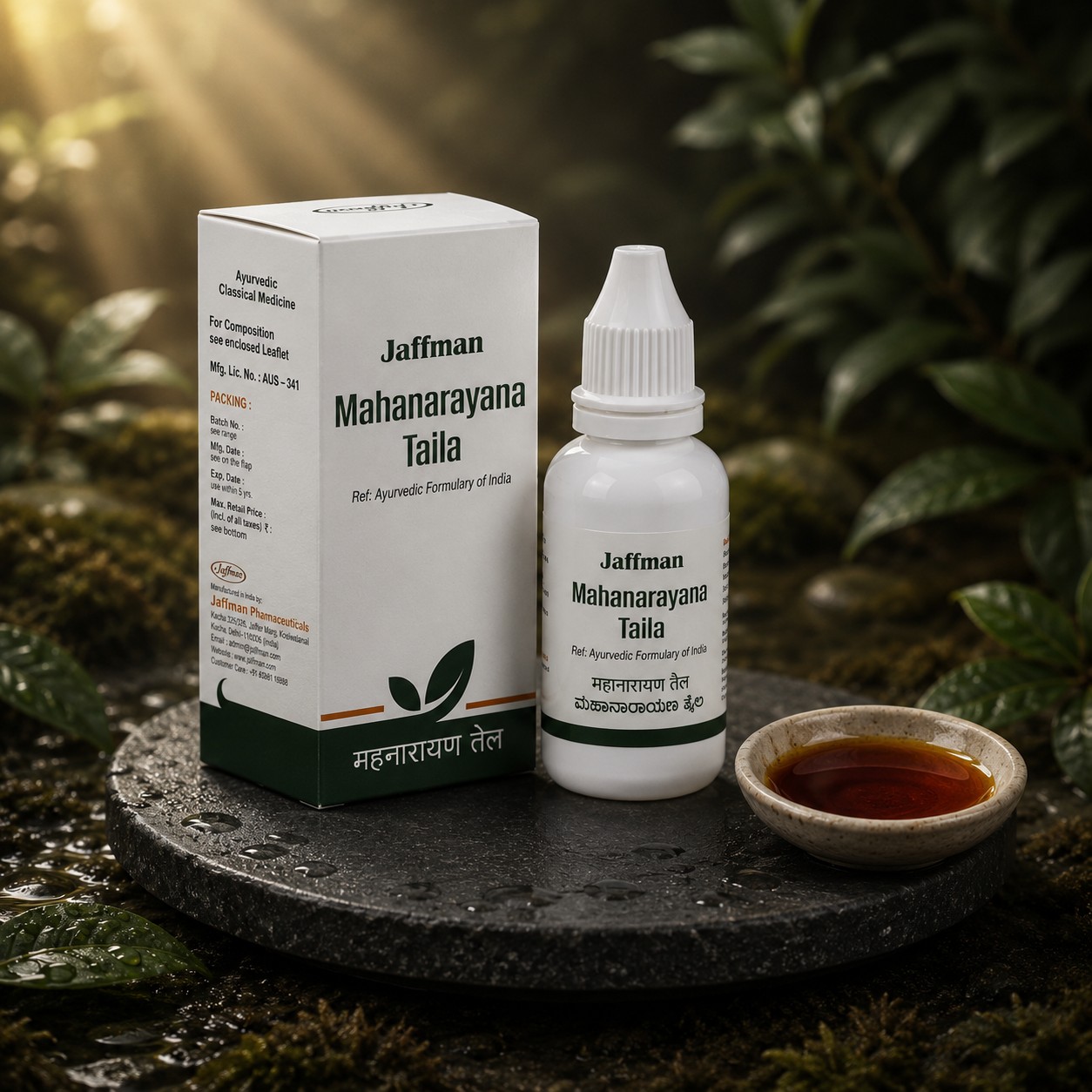
Maha Narayana Taila is one of the most celebrated and powerful classical Ayurvedic medicated oils, renowned for its exceptional versatility in managing Vata disorders, neuromuscular conditions, joint diseases, and overall debility. Mentioned in authoritative Ayurvedic texts, this oil has been used for centuries to promote strength, longevity, and resilience.
The formulation is named after Lord Narayana (Vishnu)—the sustainer of the universe—symbolizing its role in nourishing, protecting, and restoring the body. Classical literature even narrates that Lord Vishnu prepared this oil to restore the strength of wounded warriors during battles between gods and demons.
Classical Reference – Method of Preparation
बिल्वाश्वगन्धाबृहतीश्वदंष्ट्राश्योनाकवाट्यालकपारिभद्रम्।
क्षुद्राकठिल्लाग्निबलाग्निमन्थंमूलानिचैषांसरणीयुतानाम्।
मूलंविदध्यादथपाटलीनांप्रस्थंसपादंविधिनोद्धृतानाम्।
द्रोणैरपामष्टभिरेवपक्त्वापादावशेषेणरसेनतेन॥
तैलाढकाभ्यांसममेवदुग्धमाजंनिदध्यादअथवापिगव्यम्।
एकत्रसम्यग्विपचेत्सुबुद्धिर्दद्याद्रसच्चैवशतावरीनाम्।
तैलेनतुल्यंपुनरेवतत्ररास्नाश्वगन्धमिषिदारुकुष्ठम्।
पर्णीचतुष्कागरुकेशराणिसिन्धूत्थमांसिरजनीद्वयश्च॥
शैलेयकंचन्दनपुष्करणिएलास्रयष्टीतगराब्दपत्रं।
भ्रंगाष्टवर्गाम्बुवचापलाशंस्थौणेयवृश्चीरकचोरकाख्यम्॥
एतैःसमस्तैर्दिपलप्रमाणैरालोड्यसर्वंविधिनाविपक्वम्।
कर्पूरकाश्मीरमृगाण्डजानांचूर्णीकृतानांत्रिपलप्रमाणम्॥
प्रस्वेददौर्गन्ध्यनिवारणायदध्यात्सुगन्धायवदन्तिकेचित्।
नारायणंनाममहच्चतैलंसर्वप्रकारैर्विधिवत्प्रयोज्यम्।I
(Bhaisajya Ratnavali, Vatavyadhi adhikara)
Maha Narayana Taila is prepared following a complex and meticulous classical process, involving decoction (Kwatha), swarasa (juice), herbal paste (Kalka), milk, and sesame oil, cooked slowly to ensure maximum potency.
Method of Preparation (Traditional Process)
1. Preparation of Decoction (Kwatha)
A decoction is prepared using 960 g each of the following coarse herbal powders:
· Bilwa (Aegle marmelos)
· Ashwagandha (Withania somnifera)
· Brihati (Solanum indicum)
· Swadamshtra (Gokshura) (Tribulus terrestris)
· Shyonaka (Oroxylum indicum)
· Bala (Sida cordifolia)
· Paribhadra (Erythrina variegata)
· Kshudra Kantakari (Solanum xanthocarpum)
· Atibala (Abutilon indicum)
· Agnimantha (Premna corymbosa)
· Prasarini (Paederia foetida)
· Patala (Stereospermum suaveolens)
These herbs are boiled in 98 liters of water, reduced to 24 liters, and filtered.
2. Oil & Liquid Media
· Sesame oil (Tila Taila) – 6.1 kg (heated to remove moisture)
· Milk (Dugdha) – 6.14 liters
· Shatavari juice (Asparagus racemosus) – 6.1 liters
3. Preparation of Kalka (Herbal Paste)
Fine powders (96 g each) of the following herbs are used:
Rasna, Ashwagandha, Mishreya, Devadaru, Kusta, Shalaparni, Prishniparni, Mudgaparni, Mashaparni, Agaru, Nagakesara, Saindhava, Jatamamsi, Haridra, Daruharidra, Shaileya, Chandana, Pushkara, Ela, Manjishta, Yashtimadhu, Tagara, Musta, Tejapatra, Bhringaraja, Jivaka, Rishabhaka, Meda, Mahameda, Kakoli, Ksheera Kakoli, Riddhi, Vriddhi, Ambu, Vacha, Sthauneya, Vrishchikali, Choraka.
4. Final Processing
The decoction, kalka, goat milk, and Shatavari juice are combined with sesame oil and cooked on mild heat (Mridu Paka).
After filtration, 48 g each of:
· Karpoora (Camphor) – Cinnamomum camphora
· Kashmeera (Saffron) – Crocus sativus
· Mrigamada (Musk)
are added to enhance fragrance and therapeutic efficacy.
Therapeutic Uses & Benefits of Maha Narayana Taila
आश्वेवपुंसापवनार्दितानामेकान्गहीनार्दितवेपनानाम्।
येपङ्गवःपीठविसर्पिणश्चबाधिर्यशुक्रक्षयपीडिताश्च॥
मन्याहनुस्तम्भशिरोरूजार्तामुक्तामयास्तेबलवर्णयुक्ताः।
संसेव्यतैलंसहसाभवन्तिवन्ध्याचनारीलभतेचपुत्रम्॥
वीरोपमंसर्वगुणोपपन्नंसुमेधसंश्रीविनयान्वितन्च।
शाखाश्रितेकोष्ठगतेचवातेवृद्धौविधेयंपवनार्दितानाम्॥
जिह्वानिलेदन्तगतेचशूलेउन्मादकौब्ज्यज्वरकर्षितानाम्
प्राप्नोतिलक्ष्मींप्रमदाप्रियत्वंवपुःप्रकर्षविजयन्चनित्यम्॥
तैलोपसेवीजरयाभिमुक्तोजीवेच्चिराच्चापिभवेध्युवेव।
देवासुरेयुद्धपरेसमीक्ष्यस्नाय्वस्थिभघ्नानसुरैसुरांश्च।
नारायणेनापिसुबृंहणार्थंस्वनामतैलंविहितन्चतेषाम्॥
(Bhaisajya ratnavali Vatavyadhi adhikara)
Classical texts praise Maha Narayana Taila as a Sarva-Vata-Vyadhi-Nashaka (destroyer of all Vata disorders).
Indications as per Ayurveda
1. Sarvanga Vata – Generalized Vata disorders
2. Ardita – Facial palsy
3. Ekanga Heena – Paralysis of one limb
4. Vepana – Tremors
5. Pangu – Lameness, paraplegia
6. Peeta Visarpa – Weakness of lower back
7. Badhirya – Hearing impairment
8. Shukra Kshaya – Low sperm count, infertility
9. Manya Stambha – Neck stiffness
10. Hanu Stambha – Jaw stiffness
11. Shiroruja – Headache
12. Mukta Amaya – Promotes strength, immunity, and radiant complexion
13. Vandhya Stri – Helps overcome female infertility
14. Shakha Ashrita Vata – Peripheral Vata disorders
15. Koshtha Gata Vata – Visceral Vata imbalance
16. Vridha – Hernia
17. Jihva Nila – Tongue-related Vata disorders
18. Danta Gata Shoola – Toothache
19. Unmada – Mental disturbances
20. Kubja – Kyphosis (hunchback)
21. Jvara – Fever
22. Snayu & Asthi Bhagna – Muscle tears, ligament injuries, fractures
Unique Classical Claims
· Enhances strength, stamina, and vitality
· Delays aging and promotes longevity
· Improves fertility and progeny quality
· Strengthens nerves, muscles, joints, and bones
· Attracts prosperity, charm, and success
· Maintains youthfulness with regular use
तैलोपसेवीजरयाविमुक्तोजीवेत्चिराच्चापिभवेद्ध्रुवम्।
Regular use keeps the body youthful and free from the effects of aging.
Mode of Use
· Abhyanga (external massage) – daily or as prescribed
· Pichu / Basti / Nasya – under Ayurvedic supervision
· Internal use – only under physician guidance